
Elevating Community Onboarding: Insights and Strategies for 2026
- Mar 4
- 5 min read
Updated: Mar 6
Onboarding Matters
In the age of AI, communities differentiate organizations by offering real experiences, human connection, personal context, and trusted peer relationships.
While this desire for connection is rooted in human psychology, setting your online community up for success is a bit more mechanical. The latest industry benchmarks reinforced that the quality of a member’s first interaction dictates the trajectory of the entire member lifecycle.
Successful onboarding is the foundation of a thriving online community, especially for organizations seeking deeper member engagement and long-term retention. According to Higher Logic’s 2025 Association Member Experience Report, members who say it was “very easy” to get involved report 95% engagement and 93% five-year renewal intent. On the other hand, those who found it “difficult” to get involved show 18% engagement and a 64% five-year renewal intent.

“Onboarding should set the tone and show members how to participate with confidence, without feeling overwhelmed from the start. I believe this works best when we focus on the member’s problem first and make it simple for them to understand how to use the space and access its value. That clarity and simplicity is essential to long-term success.”
Will Allen
Board Member, Community Consultants Collective
As highlighted in The Member Engagement Show podcast episode, Higher Logic’s Georgina Donahue shared how thoughtful onboarding practices can transform a first-time login into a lasting relationship: “Onboarding is absolutely everything. I cannot possibly understate it. If you are not creating a great onboarding process, you’re not allowed to be surprised when things get quiet.”
It’s time to stop overlooking onboarding. It is a critical success factor for all online communities and requires strategic investment. The primary obstacle to that investment? A perceived lack of time.
Time Isn’t the Real Barrier – Perceived Value Is
Community builders and consultants often hear members say they don’t engage because they “don’t have time.” In reality, time scarcity signals unclear or delayed value. When people say they don’t have time, they’re really saying they don’t perceive enough value to make time.
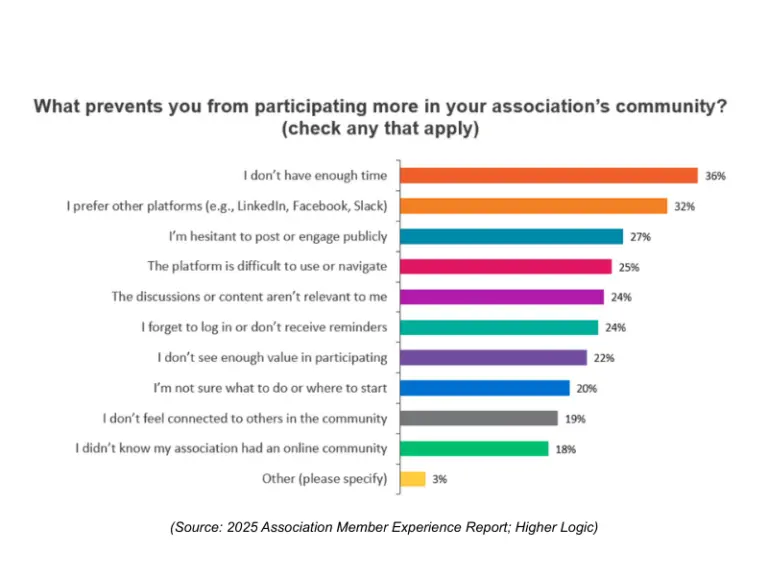
The 2025 Association Member Experience Report showed the top barrier to engagement, self-reported by members, to be “lack of time” (36%). The second most common barrier to engagement was reported as “hesitation to post publicly” (27%). These are concerns that community professionals can address upfront with new members through a thoughtful onboarding journey.
Todd Nilson, president of the Community Consultants Collective, adds that this pathway isn’t merely for navigation, but has a more strategic goal: an identity shift from being a passive observer to becoming an active stakeholder. Facilitating even small actions for new members represents a “micro-win” that builds confidence, commitment, and a sense of belonging.
Actionable Onboarding Tips from Industry Experts
Catherine Hackney, board member of the Community Consultants Collective, cautions, “members unsubscribe when the value is not obvious and they feel they are drowning in emails. But when value is tangible – through a quick question answered or new connection sparked – members will pay attention to the notifications coming from your community and return over and over to the platform, discussions, and events.”
Communities do not fail overnight, but they can easily fade and become obsolete. A strategic onboarding journey keeps your community thriving.
Will Allen suggests, “start by defining a ‘what to do first’ pathway that’s simple and clearly visible.” Focusing on one action at a time that will lead members step-by-step to experiencing the value of the community for themselves. When members experience receiving value from something, they will make time to engage with it.
To execute this, categorize your onboarding tools by the member’s psychological need:
For Social Safety & Warmth: Use introductory discussions and welcome messaging that feels “human-sent” rather than automated.
For Platform Literacy: Implement interactive tutorials and quick-start guides to “demystify” the tech.
For Immediate Value: Direct new members to high-value resources, active discussions, and other members like them so they see the community in motion.
When these pathways are designed well, Allen notes, it results in a member who eventually becomes an advocate for your brand.
The 2025 Association Community Benchmark Report reveals that communities that invest in automation and engagement design see two times more logins and higher contributor and discussion rates. These tools are most effective when paired with clear onboarding journeys. Without a clear onboarding journey, members can easily ignore the community entirely.

All organizations that host an online community should be purposefully incorporating interactive tutorials, quick-start guides, videos, and community introductions in the member journey. Expose members to active discussions, high-value resources, and community norms through messaging that feels warm and welcoming, like a real person is showing them around, not an automation rule (though you should utilize automation rules or Smart Campaigns to ensure communication is sent to the right people at the right time). These elements not only demystify the platform but also foster a sense of belonging early in their journey.
Joining a community without guidance feels awkward, risky, and isolating. Actively encouraging new members to participate in introductory discussions and immediately connect with others through strategic onboarding steps proves the tangible value the community has to offer and increases their loyalty to your organization. Members who feel connected to your organization are less likely to churn. Some will even become super users and advocates for your brand.
“While the initial 30 days are critical,we must move away from the ‘onboarding-as-a-funnel’ mindset. Instead, think of onboarding as a continuous loop. True community-led growth happens when you ‘re-onboard’ members at key milestones – such as their first anniversary or their 50th contribution – to introduce them to deeper layers of value and community tools they weren’t ready to process on day 1.”
Todd Nilson
President, Community Consultants Collective
Leveraging Technology and Resources
Scaling the onboarding loops described by Nilson requires moving beyond manual outreach; automating key tasks – like triggered welcome sequences and milestone tracking – is what allows community managers to shift their focus to high-impact relationship building. Donahue notes, “AI hasn’t changed the human condition. People still want to be seen, heard, and learn from real experiences.”
Maintaining these human touchpoints is why Hackney recommends that organizations invest in a full-time Community Manager to oversee these systems. As she puts it: “It’s a big job to keep an online community healthy… You can’t ‘set it and forget it.’ There is so much potential inside online communities. Make sure your organization has the strategic resources to harness it.”
Onboarding isn’t about overwhelming new members with features; it’s about reducing social friction and creating psychological safety early. By shifting from a ‘one-and-done’ funnel to the onboarding loop strategy, you transform those critical first 30 days into a permanent engine for growth. If you are ready to optimize your community strategy, reach out to an experienced consultant from the Community Consultants Collective today.
Authors
Catherine Hackney, Principal, Confident Communities Consulting
Will Allen, Online Community Consultant, Liaison Community Management
Todd Nilson, Community Strategist, Clocktower Advisors
This blog was originally published on March 3, 2026 by Higher Logic.


Comments